

EHS Software - Occupational Health and Safety Software

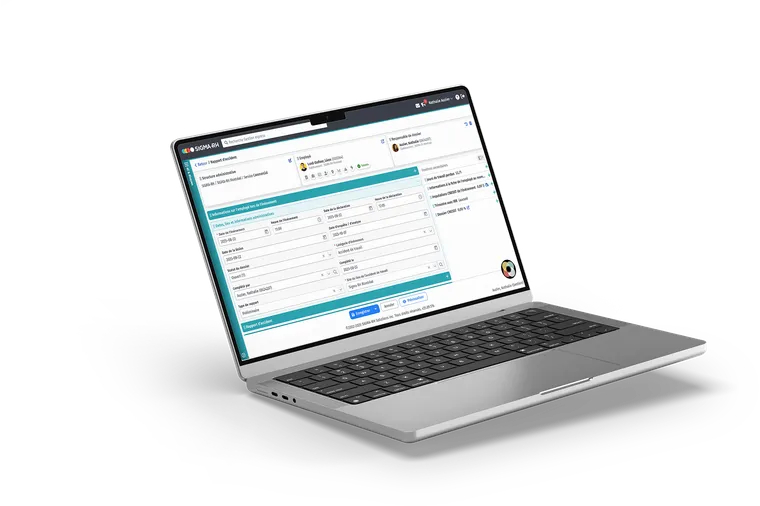
When occupational health and safety lives in scattered files and spreadsheets, compliance and performance tracking become risky: risk assessments, incidents and claims, medical/fitness-for-work checks, corrective actions, and more. The SIGMA-RH Occupational Health & Safety suite, powered by its own generative AI, brings these workflows together, automates follow-ups, and secures end-to-end traceability so you’re audit-ready at any time, while improving visibility into key indicators and the true cost of incidents and workers’ compensation claims.

Request your demo
EHS Software - Occupational Health and Safety Software

They Trust US

EHS Software - Occupational Health and Safety Software EHS Software - Occupational Health and Safety Software EHS Software - Occupational Health and Safety Software EHS Software - Occupational Health and Safety Software EHS Software - Occupational Health and Safety Software

“With SIGMA-HR, we have better control over our employees’ exposure to occupational hazards. We also save a lot of time in the administrative management of workplace accident files.”

HR Development Manager Céline R.

5 Specialized Modules in Occupational Health and Safety (OHS)

Icones suite sst_Accidents de travail

Workplace Accidents and Occupational Diseases Module

  • Ensure effective monitoring of workplace accidents
  • Quickly report your workplace accidents online

Explore the module

Prévention et risques

Risks and Prevention Module

  • Identify risks within your company
  • Follow your prevention plan
  • Define your corrective measures

Explore the module

Icones suite sst_Cliniques médicales

Medical Clinics Module

  • Manage the various medical assessments of employees
  • Centralize all your data
  • Automate your processes: scheduling, alerts, summaries, and more.

Explore the module

Cotisations CNESST

Workers Compensation Board Contributions Module

  • Manage all your social contributions
  • Project and calculate accident costs
  • Check work accident/occupational disease attributions

Explore the module

Icones suite sst_Vaccinations

Vaccination Module

  • Centralize all data related to employee vaccinations.
  • Create your vaccination repository
  • Schedule reminders and alerts

Explore the module

Why an Occupational Health & Safety Suite Is Essential

When health and safety is managed through scattered files and spreadsheets, compliance becomes fragile and oversight becomes nearly impossible. A dedicated Occupational Health & Safety suite standardizes key workflows: risk assessments, incident/claim management, prevention programs, and corrective action tracking, and secures traceability, especially for multi-site organizations.


Common Recurring Pain Points

  • Risk assessments and action plans are hard to keep current: irregular updates, incomplete follow-up, actions that stall.
  • Incident and claim management is time-consuming: declarations, supporting documents, follow-ups, reporting… with a real risk of missed steps.
  • Multi-site operations lack standardization: limited visibility, inconsistent reporting, complex governance.
  • Audit/inspection preparation is stressful: evidence is scattered, history is incomplete, traceability is weak.

What an Occupational Health & Safety Suite Changes In Practice

  • Centralization: risk assessments, prevention initiatives, incidents/events, documents, and actions in one place.
  • Workflow-driven processes: report → investigate → decide → correct → close, with clear owners and deadlines.
  • Strong traceability: full history, supporting evidence, action and decision tracking.
  • Executive-level oversight: consolidated multi-site KPIs plus visibility into trends and the true cost of incidents and claims.

Compliance You Can Prove

The Goal: a simple, auditable chain from risk assessment → prevention plan → actions completed, along with smoother management of incidents/claims and all related documentation. So you’re ready for inspections at any time.

Key Benefits of the Occupational Health and Safety (OHS) suite

Suite SST EN

Quality of Life at Work

Create a safer and healthier work environment for your employees by actively preventing accidents, and improve your company's image.


Operational Efficiency

Save time by automating your OHS processes (alerts and workflow follow-ups, prevention measures, medical visits, etc.), and facilitate exchanges between stakeholders.


Regulatory Compliance

Ensure compliance with the deadlines for reporting and disputing accidents, as well as the traceability of information on occupational accidents and risk exposure


Cost Savings

Control your social contributions, reduce the cost of occupational accidents, decrease overall absenteeism and avoid fines and sanctions related to non-compliance.

SST2

Use Case of the OHS Suite

The OHS Manager is responsible for preventing risks and accidents that could compromise the safety of employees and subcontractors. They advise and assist the company’s management while implementing an OHS culture that takes into account the improvement of quality of life at work.

Our OHS Suite supports them in this approach by ensuring compliance with regulatory obligations, equipping them to effectively monitor workplace accidents and occupational diseases, and reducing contributions to the Workers Compensation Board. SIGMA-HR facilitates access to and exploitation of data, optimizing high-level analyses and facilitating decision-making. Finally, by enabling the creation of statistics and reports related to the company’s objectives, it contributes to positioning the OHS Manager as a strategic player in the organization.

The Impact of The Suite On Your Organization

For HR Teams

  • Centralized risk assessments, incidents/claims, and documents: no more scattered files.
  • Automated follow-ups: actions, reminders, supporting documents, and case steps.
  • End-to-end traceability: clear history and evidence you can retrieve in seconds.
  • Consolidated reporting: manage prevention proactively instead of constantly reacting to urgent issues.
icon plus icon minus

For Finance Leadership

  • Better control of incident and workers’ compensation costs: monitoring, anomaly detection, and faster corrections.
  • Stronger forecasting: projections and scenarios to protect budgets and financial targets.
  • Clearer ROI on prevention investments: easier to justify spend with measurable impact.
  • Fewer blind spots: improved visibility into the financial impact of health & safety events.
icon plus icon minus

For Managers and EHS/OHS Leaders

  • A clear action plan: who does what, by when. Plus automated reminders.
  • Operational visibility by site/unit: top risks, overdue actions, and what needs attention now.
  • Fewer preventable lost-time incidents: prevention that’s tracked, measured, and followed through.
  • Multi-site standardization without losing local agility: consistent governance, local execution.
icon plus icon minus

For The Executive Teams

  • Proven, audit-ready compliance: risk assessment → action plan → completion, fully traceable.
  • Consolidated multi-site KPIs: make faster, better-informed decisions.
  • Lower reputational, legal, and people risk: stronger governance across health & safety.
  • Clearer visibility into workers’ comp and claim performance: better tracking of incidents, costs, and trends across the claims ecosystem.
icon plus icon minus

Discover Our Suites and Choose the Best HCM Solution

Icones Gestion administrative_Centre de services partagés
HR Management Suite
Icones Site Web MT_Temps-89
Workforce Management Suite
Icones suite talents_Entretiens
Talent Management Suite
Relations de travail
Labour Relations Suite

Key Takeaways From SIGMA-RH’s Occupational Health & Safety Suite

What is the Purpose of Occupational Health and Safety (OHS)?

The goal of Occupational Health and Safety (OHS) is to ensure a safe and healthy work environment for employees. It aims to prevent workplace accidents and occupational illnesses by identifying, assessing, and controlling work-related risks. OHS includes policies and procedures to minimize risks, training to educate employees on safe practices, and regular monitoring to ensure compliance with safety standards. By promoting employees' physical and mental health, OHS contributes to productivity and job satisfaction, while reducing costs related to accidents and sick leaves.

icon plus icon minus

How to Implement an OHS Program?

To implement an Occupational Health and Safety (OHS) program, start by assessing the risks in your work environment. Identify potential hazards and evaluate their severity. Then, develop and implement policies and procedures to control these risks. Train your employees on safety practices and ensure they understand the importance of OHS. Set up a reporting system for incidents and accidents, and regularly review procedures for improvement. Finally, commit to continuous improvement to maintain a safe and healthy work environment.

icon plus icon minus

Who is Responsible for OHS in a Company?

The responsibility for Occupational Health and Safety (OHS) is shared: the employer ensures a safe environment and complies with regulations. OHS managers, often from the HR or the Environment Health and Safety department, develop and implement safety policies, coordinate prevention, and monitor compliance. Employees must follow safety rules, use protective equipment, and report hazards. Personnel representatives, offering a consultative and control perspective, ensure the respect and adequacy of safety measures

icon plus icon minus

Why do companies move from spreadsheets to an OHS/EHS suite?

Spreadsheets don’t scale: data becomes scattered, responsibilities are unclear, follow-ups are missed, and audit preparation turns into a scramble. An OHS/EHS suite centralizes records, standardizes processes, and gives reliable visibility across sites.

icon plus icon minus

What types of events can we report and track?

Typically: injuries, occupational illnesses, near misses, hazards/observations, and safety incidents—plus all supporting documents and decisions. The goal is to turn reports into prevention actions and measurable improvements.

icon plus icon minus

How does incident reporting and investigation work in practice?

You log the event (key details + attachments), assign owners, investigate, document findings, and track the case through to closure. Strong investigations focus on root causes and lead to corrective actions, not blame.

icon plus icon minus

Does the suite support corrective actions and follow-ups to closure?

Yes. This is where suites outperform “storage tools”: actions are assigned with due dates, reminders/escalations, and status tracking. This prevents actions from stalling and creates a defensible audit trail.

icon plus icon minus

How does the suite help with inspections and audits?

It keeps evidence in one place: full history, documents, decisions, attachments, and completed actions, so you can prove what was done, when, and by whom, quickly. That “audit-ready” traceability is the point.

icon plus icon minus

Can we manage risk assessments and prevention plans?

Yes. Think “risk register / risk assessments + prevention plan”: identify hazards, assess risk, prioritize, assign mitigation actions, and track completion over time. Dashboards help you spot recurring causes and high-risk areas.

icon plus icon minus

How does it work for multi-site organizations?

A good suite standardizes forms, steps, roles, and KPIs across all sites, while still letting each site manage its local action plan. You get consolidated reporting for leadership and operational views for each location.

icon plus icon minus

What dashboards and KPIs should we expect?

Common KPIs include: incident rates, severity, near-miss trends, root causes, overdue actions, high-risk areas, time-to-close, and prevention progress. For multi-site orgs, the key is consistent definitions and consolidated views.

icon plus icon minus

Can Finance track the cost impact of incidents and claims?

Yes. The SIGMA-HR OHS/EHS suites help connect events to cost drivers (lost time, claim costs, recurring incident patterns) and support projections/scenarios so prevention priorities are easier to justify with clearer ROI.

icon plus icon minus

What’s the difference between a basic “safety tool” and a full suite?

A basic tool stores information. A suite drives execution: workflows, reminders, governance, consolidated indicators, and integration with the broader HR/operations ecosystem. So safety management becomes repeatable and measurable.

icon plus icon minus

Can the SIGMA-HR suite integrate with HRIS/ERP and reflect our org structure?

That’s usually a key requirement: syncing sites, departments, job roles, managers, and employee records reduces duplicate entry and enables reporting by site/service/role.

icon plus icon minus

We noticed that you're browsing from United States. Would you like to switch to Canada - EN?