Artificial intelligence is reshaping HR processes and automation — driving gains in productivity, data analysis, and the employee experience. Discover the key differences between an HRIS with integrated generative AI and one without.

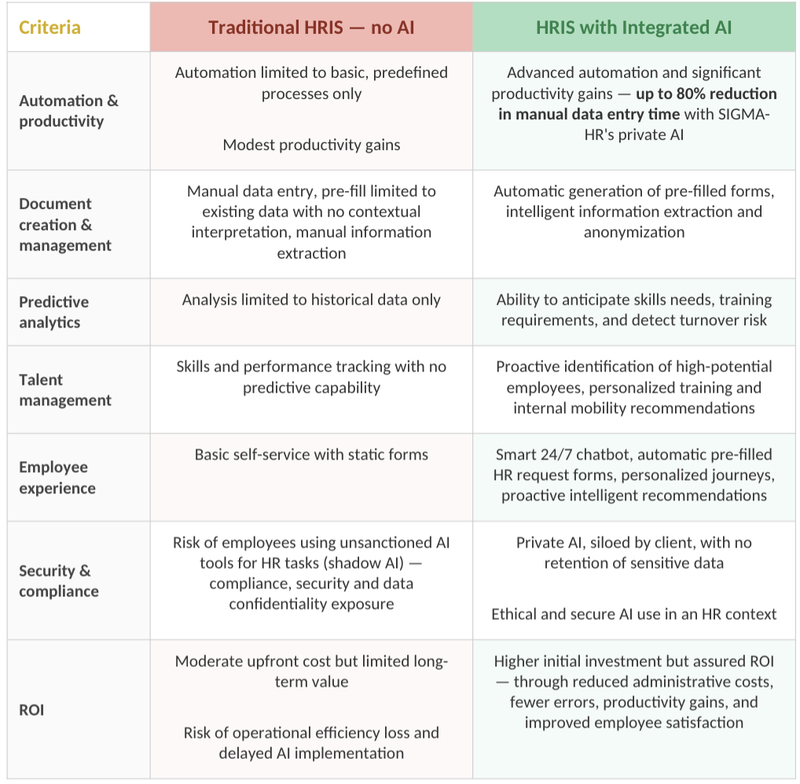
Comparison: Traditional HRIS vs. HRIS with Integrated AI
A traditional HRIS without AI offers automation limited to basic, predefined tasks — with modest productivity gains.
Manual data entry, analysis restricted to historical records, and talent management with no predictive capability all hold HR effectiveness back. Forms are static, services offer little interactivity, and the compliance risks posed by employees turning to unsanctioned external AI tools — known as shadow AI — create real data security and confidentiality exposure.
An HRIS with integrated AI, like SIGMA-HR's, takes a fundamentally different approach: intelligent process automation, up to 80% reduction in data entry time, proactive anticipation of HR needs, and a personalized employee experience delivered through smart chatbots and proactive recommendations. The AI is private, secure, and built to meet regulatory requirements.
While the initial investment is higher, it pays for itself quickly — through administrative savings, more reliable processes, and continuous improvement in HR performance.
See the difference between a HRIS with vs without AI
Book a demoHead-to-Head: Traditional HRIS vs. HRIS with Integrated AI
Why AI Changes the Game for HR
AI and human resources are not just compatible — they're a recommended combination.
Artificial intelligence is in the process of transforming HR processes, with applications spanning recruitment, training, skills management, and more.
Beyond the concrete productivity gains, AI's impact on HR shows up across multiple dimensions.
Productivity Gains
Generative AI helps HR professionals cut the time spent on administrative tasks: automatically extracting information from a résumé and creating a candidate profile, generating pre-filled documents for HR requests, answering employees' frequently asked questions through a chatbot, and more.
The AI integrated directly into SIGMA-HR, for example, reduces time spent on manual data entry by up to 80%.
AI and Recruitment Optimization
According to a study published by HelloWork in late 2024, 79% of recruiters use generative AI tools as part of their professional activities. The possibilities for AI in recruitment are extensive:
- Writing a job posting with AI
- Automatically creating and optimizing candidate profiles
- Supporting sourcing and automating the pre-screening of candidates who match target profiles
- Analyzing a candidate's technical skills and soft skills against the requirements of the role
Read more: How AI is Revolutionizing Recruitment: A Complete Guide
Data Analysis and Predictive Capabilities
AI's data analysis capabilities allow it to identify future skills needs, anticipate training requirements, and detect high-potential employees.
Artificial intelligence is accelerating the transformation of the HR function — moving it from a reactive stance to a proactive one.
To make this transition work, the HRIS needs access to quality, structured data. This is normally already the case with a global HRIS, which operates on a unified database.
Better Decision-Making
By analyzing all available HR data in real time, AI produces valuable reports that inform strategic decisions on training, workforce forecasting, recruitment, and more.
A Better Employee Experience
HRIS platforms with integrated AI also transform the employee experience. Chatbots, for example, can respond to employee questions around the clock — accurately and contextually, provided they are powered by the company's own internal policies.
With an AI-enabled HRIS, employees can submit HR requests whenever they need to and get answers to their questions faster.
Read more: AI and Talent Management: Building for Long-Term Impact
HRIS and AI: The New Standard for HR Productivity
HRIS platforms that don't leverage AI carry several significant limitations. Here are the main ones.
- Inability to effectively process the volume of HR data available. Without generative AI, the use of HR data remains shallow and often sub-optimal. Analysis is confined to basic HR metrics.
- Limited predictive analytics capabilities. An HRIS that doesn't rely on AI will be unable to anticipate future skills needs, forecast departures, or proactively identify high-potential employees.
- Under-optimized recruitment processes. HRIS platforms without integrated AI lack the capacity to effectively analyze candidate profiles, automate candidate pre-screening, or meaningfully support interview preparation.
- Basic user experience. Traditional HRIS platforms offer self-service interfaces, but users are expected to already be familiar with the navigation and procedures. They also need to enter information manually, with no proactive suggestions. Time savings are limited, and the user experience falls short.
Want to see AI in action ?
Book a demoWhat Are the Short-, Medium-, and Long-Term Risks of Staying With a Traditional HRIS?
Short-Term Risks (1–2 Years)
- Sustained administrative burden, with HR teams remaining focused on repetitive tasks that automation could free them from — time that could be redirected toward higher-value work.
- Growing productivity gap between organizations using AI in HR and those that aren't.
- Limited data analysis, with difficulty fully leveraging HR data to identify trends or anticipate needs.
- Less optimized recruitment processes: longer processing times compared to competitors already automating résumé analysis and candidate pre-screening with AI.
- Falling behind on HR automation while competitors move ahead with AI.
Medium-Term Risks (2–4 Years)
- Persistent operational costs, with no productivity gains due to continued reliance on time-consuming manual processes.
- Growing complexity in HR data management.
- Less informed HR decisions, particularly around anticipating skills needs.
- A standard employee experience that no longer meets employees' growing expectations around HR digitalization.
Long-Term Risks (3–5 Years)
- Technological obsolescence and hidden costs tied to maintaining outdated HRIS systems and the forced migrations needed to reach AI readiness.
- A strategic gap that becomes increasingly hard to close.
- Growing difficulty attracting and retaining skilled professionals who are accustomed to working with AI.
Why Move to an AI-Integrated HRIS Now?
Immediate Time and Productivity Gains
Choosing an HRIS with integrated AI can recover up to 80% of the time currently spent on manual HR data entry — and reduce the errors that come with it.
The result: HR teams can focus on higher-value activities.
A Competitive Edge in Recruitment
Organizations that adopt AI in their HR processes early and proactively gain a strategic advantage in attracting and retaining talent. Recruitment processes are simply more effective with AI.
Data Consistency and Quality
Integrating AI into a global HRIS ensures better data consistency and quality — two essential criteria for conducting reliable analyses and making well-informed decisions.
A Better Employee Experience
Employees now expect to be able to use AI to work more efficiently. The HR function must adapt to these new expectations. Offering an HRIS with integrated AI is one way to meet them.
Continuous Improvement
AI capabilities improve constantly — delivering growing benefits to organizations that adopt them early, with regular enhancements and features that quickly become indispensable.
Stronger Security and Compliance
Generative AI is reshaping every profession, and HR is no exception. HR professionals will use it regardless. The question is whether they do so within a controlled, secure environment — or whether they're pushed toward consumer-grade AI tools that aren't built for HR use and don't offer adequate security or data confidentiality guarantees.
Private AI integrated into the HRIS, like the solution offered by SIGMA-HR, meets all of these requirements: client-level data siloing, no retention of sensitive information, regulatory compliance, and more.
Ready to transform your HR processes with AI?
See the platform in actionTo Go Further
FAQ
What is an HRIS with integrated AI?
It's a human resources management system powered by multiple forms of AI. The AI's role is broad: automating tasks, analyzing HR data, supporting decision-making, and improving the employee experience.


What are the benefits of an HRIS with artificial intelligence?
It increases productivity, reduces errors, improves anticipation of skills needs, and delivers faster, more personalized HR services.
Why integrate AI into an HRIS?
AI is transforming every function, including HR: it automates repetitive tasks, strengthens data analysis, and supports strategic decision-making. It's a long-term performance driver.
What is the difference between a traditional HRIS and an AI-powered HRIS?
A traditional HRIS relies on manual processes, while an AI-powered HRIS automates actions, continuously analyzes data, and generates intelligent recommendations.
Is an HRIS with AI secure?
Yes — provided the AI is properly governed. Data is siloed by client, sensitive information is not retained, and the system meets regulatory requirements including PIPEDA and applicable provincial privacy legislation.
What are the risks of staying with a traditional HRIS?
High ongoing administrative burden, difficulty analyzing HR data, loss of competitiveness in recruitment, and a basic employee experience that no longer meets expectations.
What ROI can you expect from an HRIS with AI?
Organizations see significant time savings, fewer errors, better allocation of HR resources, and higher satisfaction among both HR teams and employees.