AI adoption among HR functions is following a similar trajectory across markets. In France, 28% of HR directors already use AI daily in 2025, up from just 9% a year earlier — adoption has tripled in a single year. Yet in most organizations, AI is still bolted on reactively: a tool gets deployed, processes get adjusted around it, and training comes later.

That model is showing its limits. Organizations that add AI "after the fact" struggle to get real value out of it: weak adoption, fragmented use cases, no clear governance.
The AI-first approach proposes a fundamentally different logic: design processes, services, and decisions with AI built in from the start. For HR, that shift has concrete implications at every level of the function.
What is an AI-first strategy? How does it differ from current practice? And how do you implement it while respecting the legal framework?
What Is an AI-First Strategy?
Definition: Thinking With AI, Not Around It
An AI-first strategy rests on a simple principle: artificial intelligence isn't a tool grafted onto existing processes. It's built in from the design phase, as a structuring lever for decisions and organization.
The question is no longer "how do we fit AI into what we already do?" but "how do we design this process by drawing on what AI can deliver from the outset?"
That shift in perspective means identifying data needs at the scoping stage, defining decision rules and human oversight before deployment, and getting ahead of compliance questions early.
AI-First vs. the Traditional Approach: The Core Difference
In a traditional approach, AI is added as an extra layer on top of processes that already exist. AI-first starts from the actual need and designs the process by drawing on AI's capabilities from day one.
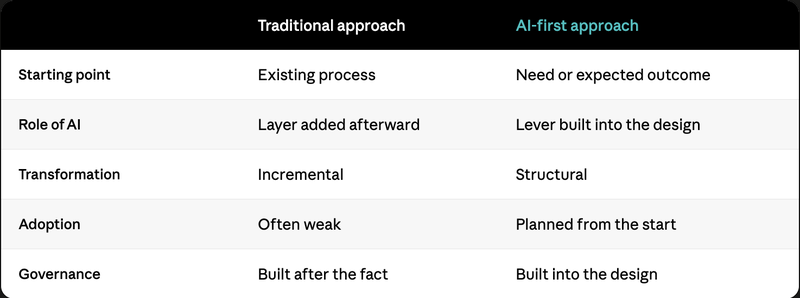
In practice, organizations that design their processes AI-first see stronger adoption, better ROI, and clearer governance.
Why the "Technology Layer" Approach Falls Short
Despite growing investment — 88% of organizations plan to increase their generative AI spending over the next year — actual adoption rates often disappoint. Employees given an AI tool stop using it within a few weeks. Three reasons come up consistently:
- the tool doesn't fit naturally into the workflow;
- expected benefits aren't immediately visible;
- and usage rules are either missing or too vague to apply.
This isn't a technical problem. It's an organizational one. When AI is bolted on after the fact, it stays peripheral: it doesn't transform processes, it just sits on top of them. Teams keep working the way they always did, adding one more step that eventually gets worked around.
A direct consequence: shadow AI. With no official framework in place, employees organize around it on their own, using unvalidated tools or personal accounts. Confidential data ends up flowing outside any regulatory control.
Read more: The Rise of AI Workslop: Low-Quality Work Generated by AI
An AI-first strategy is designed specifically to prevent this — by offering clear use cases, validated tools, and a framework everyone can understand.
Take Back Control of Your AI Usage
SIGMA-HR builds secure, governed AI directly into your HRIS — not one more tool to rein in after the fact.
Talk to our specialistsAI-First in HR: What Are the Concrete Impacts on Processes?
An AI-first approach reshapes, at a fundamental level, how HR teams design and run their core processes.
Recruitment and Screening
Trends observed elsewhere give a sense of how fast adoption is moving: according to a study of HR directors, 57% of HR leaders plan to build AI into their recruitment processes, and 39% already use it.
In an AI-first logic, AI doesn't just sort resumés. It's built in from the moment the need is defined: analyzing internal performance data to sharpen the candidate profile, screening against objective criteria, scheduling interviews, and automating communications. The fundamental shift: rules are defined and documented before deployment, not discovered afterward.
Read more: How AI Is Revolutionizing Recruitment: A Complete Guide
Training and Skills Development
In AI-first mode, skills needs are anticipated continuously, by cross-referencing people analytics data, role changes, and market shifts.
Training recommendations are personalized for each employee, early warning signs are caught sooner, and internal mobility paths are informed by real data. A learning management solution built into the HRIS makes this ongoing anticipation possible.
HR Steering and Decision Support
AI, built into the steering system from the outset, turns HR metrics into genuine decision-support tools.
It flags anomalies, anticipates risks, and suggests courses of action. Steering shifts from after-the-fact observation to anticipation.
Governance and the Legal Framework: What Canadian HR Teams Need to Know
An AI-first approach requires governance to be structured before deployment. In Canada, that legal framework is distinct from the European Union's and rests on different legislation:
- Quebec's Law 25: governs decisions based exclusively on the automated processing of personal information. When such a decision has a significant effect on a person (hiring, promotion, disciplinary action), the organization must inform them and allow them to request that an employee review the decision.
- PIPEDA (federal privacy legislation): governs the collection, use, and retention of personal data processed by HR AI tools at the federal level and in provinces without equivalent legislation.
- No federal AI-specific law yet: unlike the EU's AI Act, Canada does not yet have federal legislation in force that classifies AI systems by risk level. The proposed Artificial Intelligence and Data Act (AIDA), which would have targeted high-impact systems like recruitment, died on the order paper in 2025. Organizations must rely on provincial privacy legislation and sector best practices in the meantime.
- Labour standards and unionized workplaces: Quebec has no equivalent to France's works council (CSE). In a unionized workplace, introducing an AI tool that changes work organization is typically negotiated through the collective agreement. In non-union settings, no formal consultation is legally required, though it remains good practice.
- Occupational health and safety (WCB / CNESST): psychosocial risks tied to digital tools, including AI, need to be accounted for in the employer's prevention program.
The usage policy should spell out validated tools, the level of human oversight required for each type of decision, accountability when something goes wrong, and how employees are informed.
Conclusion
The AI-first approach isn't an ideal reserved for big tech companies. It's a common-sense discipline: start from the real need, design processes with AI in mind, and structure governance before deployment.
For HR teams, this shift in posture is significant: it's no longer about reacting to a new tool showing up — it's about anticipating, framing, and steering.
That repositioning is exactly what makes HR a key player in an organization's AI-first transformation. The ones taking this on now, methodically, combining strategic ambition with operational discipline, will likely be best positioned to turn it into lasting value.
To go further:
FAQ
What is an AI-first HR strategy?
It's an approach where AI is built into HR processes from the design stage, rather than added afterward. It means thinking through processes, data, and governance with AI's capabilities in mind from day one.


How does AI-first differ from a traditional approach?
A traditional approach grafts AI onto existing processes. AI-first starts from the real need and designs the process around AI's capabilities from the outset — leading to stronger adoption, clearer governance, and better-measured value.
What are the legal obligations around AI in HR in Canada?
Quebec's Law 25 governs decisions based solely on automated processing that have significant effects, requiring disclosure and the possibility of human review. PIPEDA governs personal information protection at the federal level. Canada does not yet have federal legislation specifically classifying AI systems by risk level.
How do you start an AI-first HR strategy?
Identify high-potential processes (high volume, reliable data, decision-making impact), define a usage policy, consult relevant stakeholders (including the union where applicable), train teams, then roll out gradually through pilot projects.
What is shadow AI, and how do you prevent it?
Shadow AI refers to employees using AI tools that haven't been validated by the organization, outside any formal framework. It's prevented by offering validated tools, clear usage rules, and an AI policy accessible to everyone.